
 ) and wanted know the definition of flooded logs. Does that mean the logs are submerged or can be seen sticking out of the water?
Talquin Log Safety Question
Moderators: bman, Tom Keels, Chalk
-
CoastalPirate

- Site Sponsor
- Posts: 177
- Joined: June 17th, 2011, 3:38 pm
- Location: Tallahassee
Talquin Log Safety Question
I've fished around the island in the middle of Talquin a few times and have a good a understanding of that general area when it comes to flooded logs.This weekend we are planning on launching from either Ben Stoutamire Rd. or Wainwright Rd. and I noticed on Navionics Talquin Map that it mentions quite a few flooded logs around those ramps as well as all of Talquin ( ) and wanted know the definition of flooded logs. Does that mean the logs are submerged or can be seen sticking out of the water?
) and wanted know the definition of flooded logs. Does that mean the logs are submerged or can be seen sticking out of the water?The hunt for the notorious green whale never ends.
Instagram: mikemincy
Youtube: MrCoastalPirate
Instagram: mikemincy
Youtube: MrCoastalPirate

Re: Talquin Log Safety Question
All of the above... try to find a pic of the lake when it is in a draw down...
The one below is allegedly from Talquin in 1984 and looks a lot like something I remember back in the late 90s:
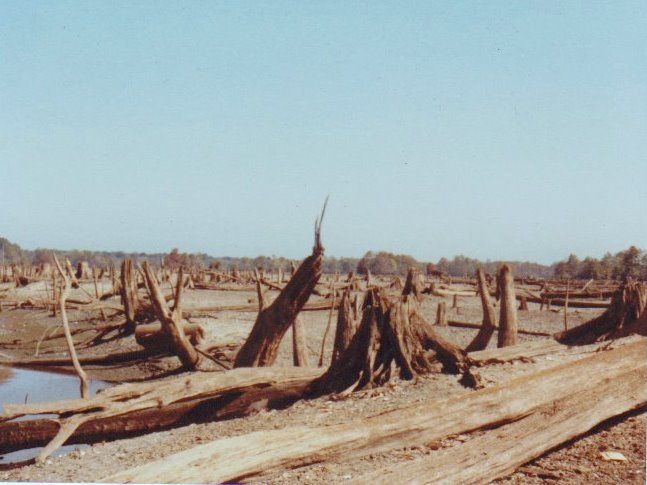
The one below is allegedly from Talquin in 1984 and looks a lot like something I remember back in the late 90s:
2008 Key West 196 Bay Reef
2008 Yamaha 150
2008 Yamaha 150

Re: Talquin Log Safety Question
Pirate, the entire lake bottom looks like the picture zload posted. My understanding is, when the lake was under construction, most of the trees were cut before the lake was flooded. The trees were left where they fell. For the most part the stumps are well below the surface. However, the shallower the water the closer to the surface the stumps.
Many years ago there were thousands of dead heads showing above the surface. Over time those portions above the surface rotted and broke off just below the water line. Alot of the dead heads got moved, or washed away, in the 80's. There was a draw down in progress when the area was hit with a flood. The lake was down about 7 feet when the flood occurred. The gates at the dam were closed and the lake was back to full pool in less than 24 hours. The amount of moving water either re positioned most of the dead heads, or washed them down the lake to deeper water. The area of the main lake from just easterly of Stoutamire/Wainright to the dam is where the dead heads are still above the surface.
Now, with all that said, I'll tell you that probably 90% of the lake is flooded timber. I've been running that lake for over 40 years. The rules of thumb I follow, and fer to anyone that asks me are:
1- In the main lake, between Williams Landing and the dam, if you can't see it you're probably OK. Above Williams is a different story.
2- When you leave the main lake and enter any creek you need to have a real good knowledge of where you are. Some places you can run. Some you can't.
3- Rules 1 and 2 don't always keep you out of trouble.
4- Buy good insurance and keep it current.
5- If you are going to run Talquin, it's not a matter of if, it's a matter of when.
Again, I've been running Talquin for over 40 years. This past January I was running an area I've been running for 30 years and broke the skeg completely off of my lower unit.
Many years ago there were thousands of dead heads showing above the surface. Over time those portions above the surface rotted and broke off just below the water line. Alot of the dead heads got moved, or washed away, in the 80's. There was a draw down in progress when the area was hit with a flood. The lake was down about 7 feet when the flood occurred. The gates at the dam were closed and the lake was back to full pool in less than 24 hours. The amount of moving water either re positioned most of the dead heads, or washed them down the lake to deeper water. The area of the main lake from just easterly of Stoutamire/Wainright to the dam is where the dead heads are still above the surface.
Now, with all that said, I'll tell you that probably 90% of the lake is flooded timber. I've been running that lake for over 40 years. The rules of thumb I follow, and fer to anyone that asks me are:
1- In the main lake, between Williams Landing and the dam, if you can't see it you're probably OK. Above Williams is a different story.
2- When you leave the main lake and enter any creek you need to have a real good knowledge of where you are. Some places you can run. Some you can't.
3- Rules 1 and 2 don't always keep you out of trouble.
4- Buy good insurance and keep it current.
5- If you are going to run Talquin, it's not a matter of if, it's a matter of when.
Again, I've been running Talquin for over 40 years. This past January I was running an area I've been running for 30 years and broke the skeg completely off of my lower unit.
What was I supposed to do today?
-
One Keeper
- Posts: 757
- Joined: October 16th, 2006, 2:32 pm
Re: Talquin Log Safety Question
What Tin Can said! EXACTLY.
-
CoastalPirate
- Site Sponsor
- Posts: 177
- Joined: June 17th, 2011, 3:38 pm
- Location: Tallahassee
Re: Talquin Log Safety Question
Whoa Zload! That picture brought some horrific images to mind and dreams of catching big bass too! Zload and Tin Can thanks for the advice! I will definitely keep my eyes out, my speed down and my insurance updated!
The hunt for the notorious green whale never ends.
Instagram: mikemincy
Youtube: MrCoastalPirate
Instagram: mikemincy
Youtube: MrCoastalPirate
Re: Talquin Log Safety Question
I've lost a lot of hal-flies and other crappie jigs on those trees. And in front of Freeman Creek a good rod and reel.
Yours in the South